3.4.5.1. Classificación

Clasificación
This tab allows for the classification of the Band set (complete interface) using the spectral signatures checked in ROI & Signature list. Several classification options are set in this tab which affect the classification process also during the Classification preview. Pretrained models are available, which require the installation of PyTorch.
Esta herramienta permite seleccionar de uno de los siguientes algoritmos
También es posible guardar y cargar un clasificador previamente entrenado.
Truco
Information about APIs of this tool in Remotior Sensus at this link .
3.4.5.1.1. Entrada
Símbolo de la herramienta y nombre |
Descripción |
|---|---|
Seleccionar el conjunto de bandas de entrada |
selecciona el Band set (complete interface) a clasificar |
|
si está marcado, normaliza los datos de entrada usando uno de los métodos seleccionados |
|
si está marcado con |
|
si está marcado con |
Usar entrenamiento con |
si está marcado la clasificación se realizará usando |
usar entrenamiento con |
si está marcado, la clasificación se realizará usando el ID de Clase (código C ID de la firma) |


3.4.5.1.2. Algoritmo
Esta herramienta permite seleccionar del algoritmo de clasificación. La pestaña de algoritmo incluye los parámetros disponibles.
3.4.5.1.2.1. Máxima Probabilidad
Máxima Probabilidad
Usar el algoritmo de Maximum Likelihood.
Símbolo de la herramienta y nombre |
Descripción |
|---|---|
Usar un único umbral |
si está marcado, permite definir el umbral de clasificación (aplicado a todas las firmas espectrales), los píxeles quedaran sin clasificar si la probabilidad es mejor que valor umbral (max. 100) |
Umbral de las firmas |
si está marcado, los umbrales Signature threshold (complete interface) son evaluados |
|
abre la Signature threshold (complete interface) para definir los umbrales para las firmas |
|
si está marcado, además del ráster de la clasificación, se generara un ráster para cada firma espectral en el mismo directorio de salida, el cual representa la distancia entre los valores espectrales de un pixel y la firma. |
|
si está marcado, se calculará el ráster de confiabilidad de la clasificación |

3.4.5.1.2.2. Distancia mínima
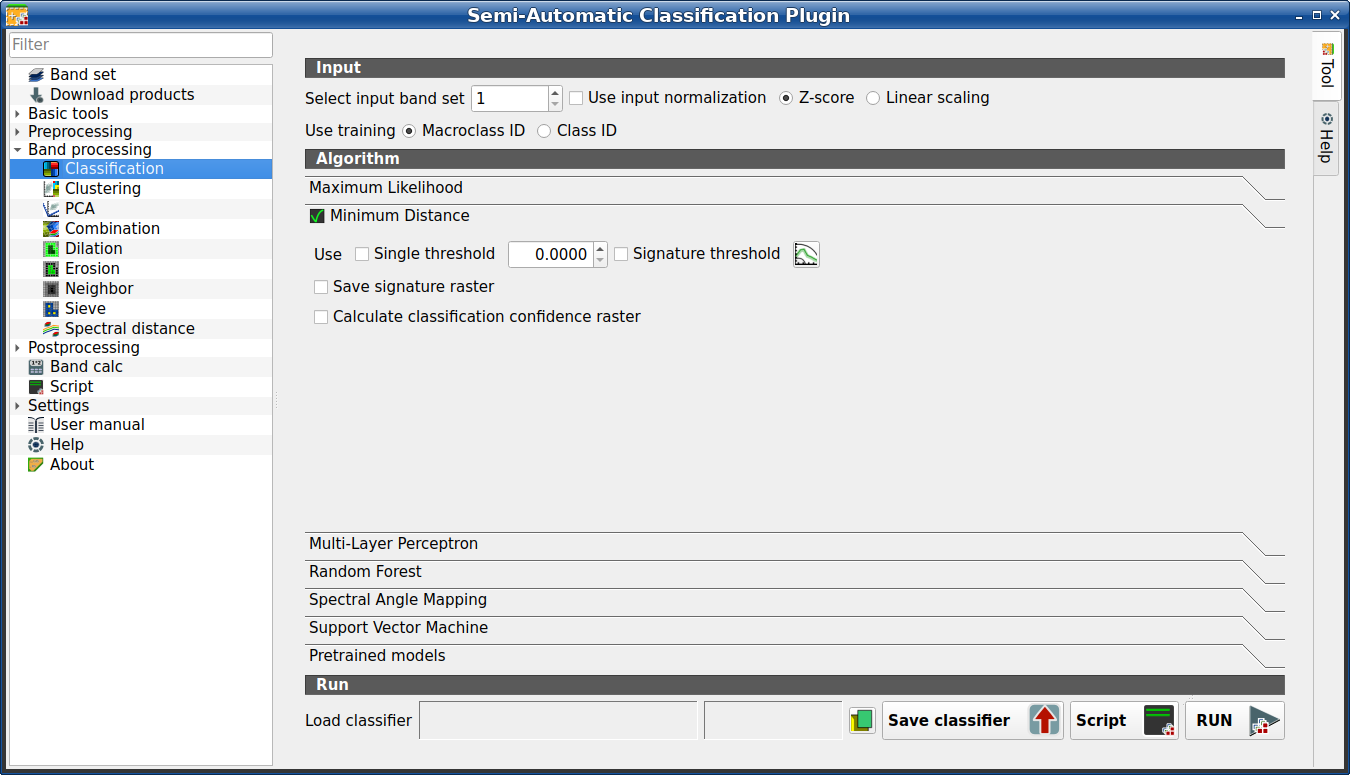
Distancia Mínima
Usa el algoritmo de Minimum Distance.
Símbolo de la herramienta y nombre |
Descripción |
|---|---|
Usar un único umbral |
si está marcado, permite la definición de un umbral de clasificación (aplicado a todas las firmas espectrales), los píxeles no serán clasificados si la distancia es mayor al valor umbra |
Umbral de las firmas |
si está marcado, los umbrales Signature threshold (complete interface) son evaluados |
|
abre la Signature threshold (complete interface) para definir los umbrales para las firmas |
|
si está marcado, además del ráster de la clasificación, se generara un ráster para cada firma espectral en el mismo directorio de salida, el cual representa la distancia entre los valores espectrales de un pixel y la firma. |
|
si está marcado, se calculará el ráster de confiabilidad de la clasificación |
3.4.5.1.2.3. Perceptron Mutli-capa
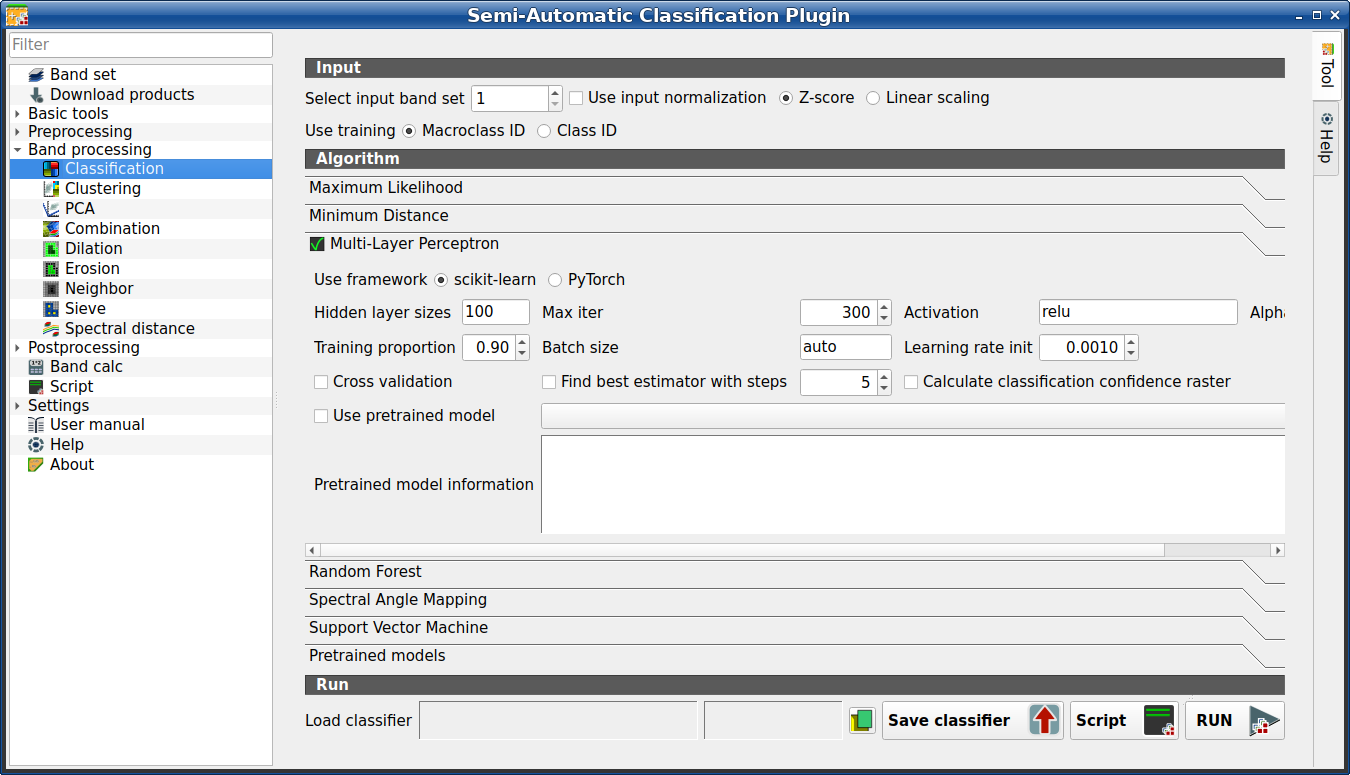
Perceptron Multi-capa
Usa el algoritmo de Multi-Layer Perceptron.
Símbolo de la herramienta y nombre |
Descripción |
|---|---|
Usa el framework de |
si está marcado, usar el framework de scikit-learn (lee esto) |
Usa el framework |
si está marcado, se usa el framework PyTorch (lee estos) |
Tamaño de capas ocultas |
lista de valores separados por comas, en la que cada valor define el número de neuronas en una capa oculta (e.g.: 200, 100 for two hidden layers of 200 and 100 neurons respectively) |
Iter. Max. |
define el número máximo de iteraciones |
Activación |
define la función de activación (por defecto: relu) |
Alpha |
define el decaimiento de pesos (también el término de regularización L2) para el optimizador Adam |
Proporción de entrenamiento |
define la proporción de los datos que serán utilizados para entrenamiento, el resto será el conjunto de datos para prueba |
Tamaño del Batch |
define el número de muestra por lote para el optimizador, si se deja por defecto, el tamaño será el mínimo entre 200 o el número de muestras |
Tasa de aprendizaje inicial |
define la tasa de aprendizaje inicial |
|
si está marcado, se llevará acabo una validación cruzada |
|
si está marcado, eneuntra el mejor estimador iterativamente usando un número de pasos |
|
si está marcado, se calculará el ráster de confiabilidad de la clasificación |
|
if checked, use the selected pretrained model from the list |
Pretrained model information |
information about the selected pretrained model, in particular about the requirements (which input bands), band normalization, and model source. |


Cross validation is a function provided by scikit-learn to
avoid overfitting by splitting the training set into k smaller sets
(read more .
In particular, the function StratifiedKFold (with parameters n_splits=5,
shuffle=True) is used to create 5 sets, each one containing approximately the
same percentage of samples for each class as the complete set.
This option can potentially increase significantly the computation time.
If Find best estimator with steps is checked, the algorithm tries to find the best estimator iteratively with the defined number of steps (the more the steps, the slower the process will be), by changing the algorithm parameters.
Pretrained models can be selected to create embeddings which are used with training input to train the classifier. The following Pretrained models are available for classification:
Swin-v2-Base model for Sentinel-2 single image. Requirements: Sentinel-2 bandset (TCI RGB (B04, B03, B02), TOA bands B05, B06, B07, B08, B11, B12). Normalization: TCI RGB bands divided by 255; B05, B06, B07, B08, B11, B12 divided by 8160 and clipped to 0-1. Framework: PyTorch. Source: Sentinel2_SwinB_SI_MS, pretrained by the Allen Institute for Artificial Intelligence (SatlasPretrain: https://satlas-pretrain.allen.ai). The model weights are released under the Open Data Commons Attribution License (ODC-BY). The repository code is licensed under the Apache License 2.0 (https://huggingface.co/allenai/satlas-pretrain). This tool downloads the official SatlasPretrain weights (Bastani et al., «SatlasPretrain: A Large-Scale Dataset for Remote Sensing Image Understanding», ICCV 2023, arXiv:2211.15660, https://doi.org/10.48550/arXiv.2211.15660). All model weights remain the property of their respective authors.
Swin-v2-Tiny model for Sentinel-2 single image. Requirements: Sentinel-2 bandset (TCI RGB (B04, B03, B02), TOA bands B05, B06, B07, B08, B11, B12). Normalization: TCI RGB bands divided by 255; B05, B06, B07, B08, B11, B12 divided by 8160 and clipped to 0-1. Framework: PyTorch. Source: Sentinel2_SwinT_SI_MS, pretrained by the Allen Institute for Artificial Intelligence (SatlasPretrain: https://satlas-pretrain.allen.ai). The model weights are released under the Open Data Commons Attribution License (ODC-BY). The repository code is licensed under the Apache License 2.0 (https://huggingface.co/allenai/satlas-pretrain). This tool downloads the official SatlasPretrain weights (Bastani et al., «SatlasPretrain: A Large-Scale Dataset for Remote Sensing Image Understanding», ICCV 2023, arXiv:2211.15660, https://doi.org/10.48550/arXiv.2211.15660). All model weights remain the property of their respective authors.
Swin-v2-Base model for Landsat 8 or Landsat 9 single image. Requirements: Landsat 8 or Landsat 9 bandset (Collection 2 Level-1 bands B01, B02, B03, B04, B05, B06, B07, B08, B09, B10, B11); Normalization: (band - 4000)/16320 and clipped to 0-1. Framework: PyTorch. Source: Landsat_SwinB_SI, pretrained by the Allen Institute for Artificial Intelligence (SatlasPretrain: https://satlas-pretrain.allen.ai). The model weights are released under the Open Data Commons Attribution License (ODC-BY). The repository code is licensed under the Apache License 2.0 (https://huggingface.co/allenai/satlas-pretrain). This tool downloads the official SatlasPretrain weights (Bastani et al., «SatlasPretrain: A Large-Scale Dataset for Remote Sensing Image Understanding», ICCV 2023, arXiv:2211.15660, https://doi.org/10.48550/arXiv.2211.15660). All model weights remain the property of their respective authors.
Truco
The installation of PyTorch is required to run pretrained models. Please note that each model has specific characteristics and specific preprocessing of input image.
3.4.5.1.2.4. Bosque Aleatorio

Usar el algoritmo Random Forest
Símbolo de la herramienta y nombre |
Descripción |
|---|---|
Número de árboles |
define el número de árboles |
Minimum number to split |
define el número mínimo de muestras requerido para dividir un nodo interno |
Objetos máximos |
para la división de nodos, si está vacío se consideran todos los objetos; si es sqrt la raíz cuadrada de de todos los objetos, si es integer el número entero de objetos; si es un número decimal la fracción correspondiente de objetos |
|
si está marcado, realizar una clasificación Uno-Vs-Resto (leer mas) |
|
si está marcado, se llevará acabo una validación cruzada |
|
si está marcado, se calcula un peso balanceado siendo inversamente proporcional a la frecuencia de las clases |
|
si está marcado, eneuntra el mejor estimador iterativamente usando un número de pasos |
|
si está marcado, se calculará el ráster de confiabilidad de la clasificación |
|
if checked, use the selected pretrained model from the list |
Pretrained model information |
information about the selected pretrained model, in particular about the requirements (which input bands), band normalization, and model source. |
Cross validation is a function provided by scikit-learn to
avoid overfitting by splitting the training set into k smaller sets
(read more .
In particular, the function StratifiedKFold (with parameters n_splits=5,
shuffle=True) is used to create 5 sets, each one containing approximately the
same percentage of samples for each class as the complete set.
This option can potentially increase significantly the computation time.
If Find best estimator with steps is checked, the algorithm tries to find the best estimator iteratively with the defined number of steps (the more the steps, the slower the process will be), by changing the algorithm parameters.
If One-Vs-Rest is checked, the algorithm performs One-Vs-Rest classification which basically fits one classifier per class.
If Balanced class weight is checked, the algorithm gives all classes equal weight with a balanced weight that is computed inversely proportional to class frequency in the training data.
Pretrained models can be selected to create embeddings which are used with training input to train the classifier. The following Pretrained models are available for classification:
Swin-v2-Base model for Sentinel-2 single image. Requirements: Sentinel-2 bandset (TCI RGB (B04, B03, B02), TOA bands B05, B06, B07, B08, B11, B12). Normalization: TCI RGB bands divided by 255; B05, B06, B07, B08, B11, B12 divided by 8160 and clipped to 0-1. Framework: PyTorch. Source: Sentinel2_SwinB_SI_MS, pretrained by the Allen Institute for Artificial Intelligence (SatlasPretrain: https://satlas-pretrain.allen.ai). The model weights are released under the Open Data Commons Attribution License (ODC-BY). The repository code is licensed under the Apache License 2.0 (https://huggingface.co/allenai/satlas-pretrain). This tool downloads the official SatlasPretrain weights (Bastani et al., «SatlasPretrain: A Large-Scale Dataset for Remote Sensing Image Understanding», ICCV 2023, arXiv:2211.15660, https://doi.org/10.48550/arXiv.2211.15660). All model weights remain the property of their respective authors.
Swin-v2-Tiny model for Sentinel-2 single image. Requirements: Sentinel-2 bandset (TCI RGB (B04, B03, B02), TOA bands B05, B06, B07, B08, B11, B12). Normalization: TCI RGB bands divided by 255; B05, B06, B07, B08, B11, B12 divided by 8160 and clipped to 0-1. Framework: PyTorch. Source: Sentinel2_SwinT_SI_MS, pretrained by the Allen Institute for Artificial Intelligence (SatlasPretrain: https://satlas-pretrain.allen.ai). The model weights are released under the Open Data Commons Attribution License (ODC-BY). The repository code is licensed under the Apache License 2.0 (https://huggingface.co/allenai/satlas-pretrain). This tool downloads the official SatlasPretrain weights (Bastani et al., «SatlasPretrain: A Large-Scale Dataset for Remote Sensing Image Understanding», ICCV 2023, arXiv:2211.15660, https://doi.org/10.48550/arXiv.2211.15660). All model weights remain the property of their respective authors.
Swin-v2-Base model for Landsat 8 or Landsat 9 single image. Requirements: Landsat 8 or Landsat 9 bandset (Collection 2 Level-1 bands B01, B02, B03, B04, B05, B06, B07, B08, B09, B10, B11); Normalization: (band - 4000)/16320 and clipped to 0-1. Framework: PyTorch. Source: Landsat_SwinB_SI, pretrained by the Allen Institute for Artificial Intelligence (SatlasPretrain: https://satlas-pretrain.allen.ai). The model weights are released under the Open Data Commons Attribution License (ODC-BY). The repository code is licensed under the Apache License 2.0 (https://huggingface.co/allenai/satlas-pretrain). This tool downloads the official SatlasPretrain weights (Bastani et al., «SatlasPretrain: A Large-Scale Dataset for Remote Sensing Image Understanding», ICCV 2023, arXiv:2211.15660, https://doi.org/10.48550/arXiv.2211.15660). All model weights remain the property of their respective authors.
Truco
The installation of PyTorch is required to run pretrained models. Please note that each model has specific characteristics and specific preprocessing of input image.
3.4.5.1.2.5. Mapeo del Angulo Espectral
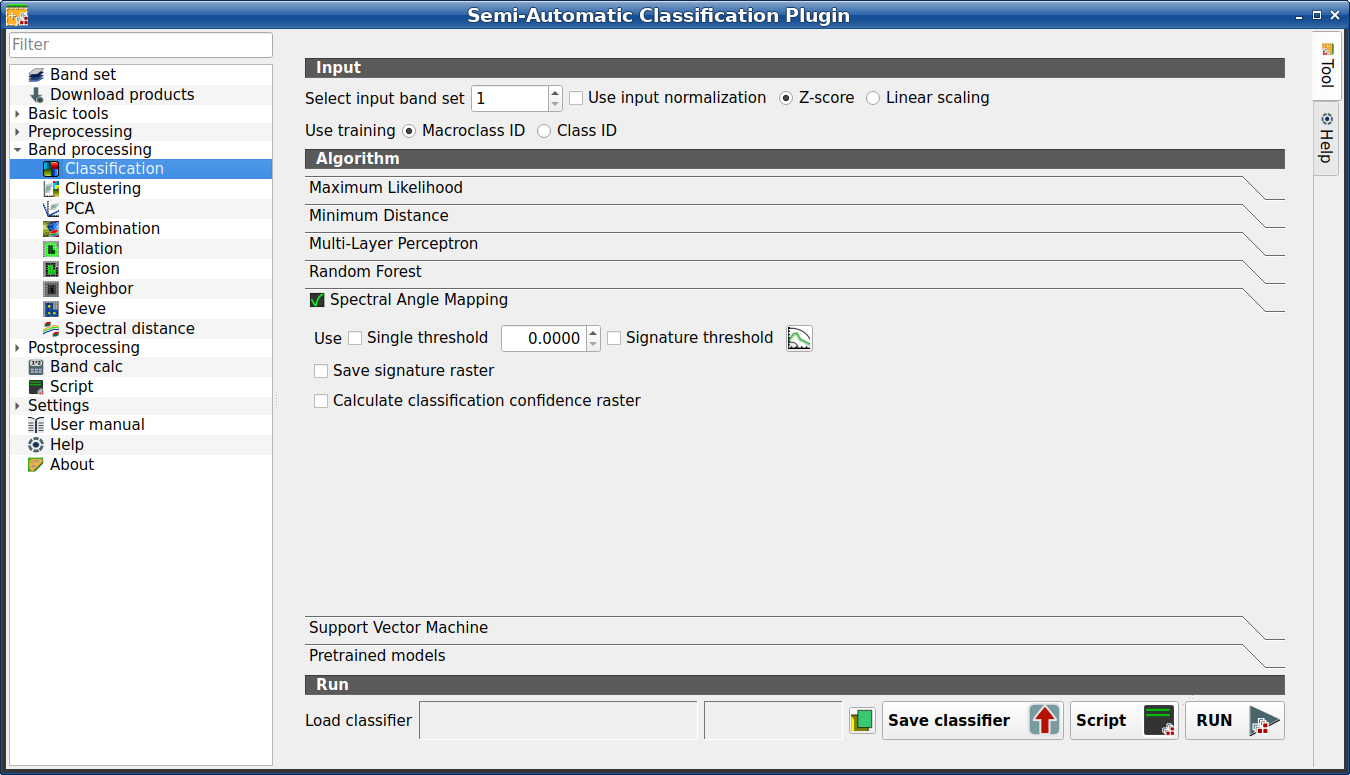
Mapeo de Angulo Espectral
Usa el algoritmo de Spectral Angle Mapping.
Símbolo de la herramienta y nombre |
Descripción |
|---|---|
Usar un único umbral |
si está marcado, permite definir el umbral para la clasificación (aplicado a las firmas espectrales); los píxeles no son clasificados si la distancia angular espectral es superior al umbra (máx. 90) |
Umbral de las firmas |
si está marcado, los umbrales Signature threshold (complete interface) son evaluados |
|
abre la Signature threshold (complete interface) para definir los umbrales para las firmas |
|
si está marcado, además del ráster de la clasificación, se generara un ráster para cada firma espectral en el mismo directorio de salida, el cual representa la distancia entre los valores espectrales de un pixel y la firma. |
|
si está marcado, se calculará el ráster de confiabilidad de la clasificación |
3.4.5.1.2.6. Máquinas de Soporte de Vectores
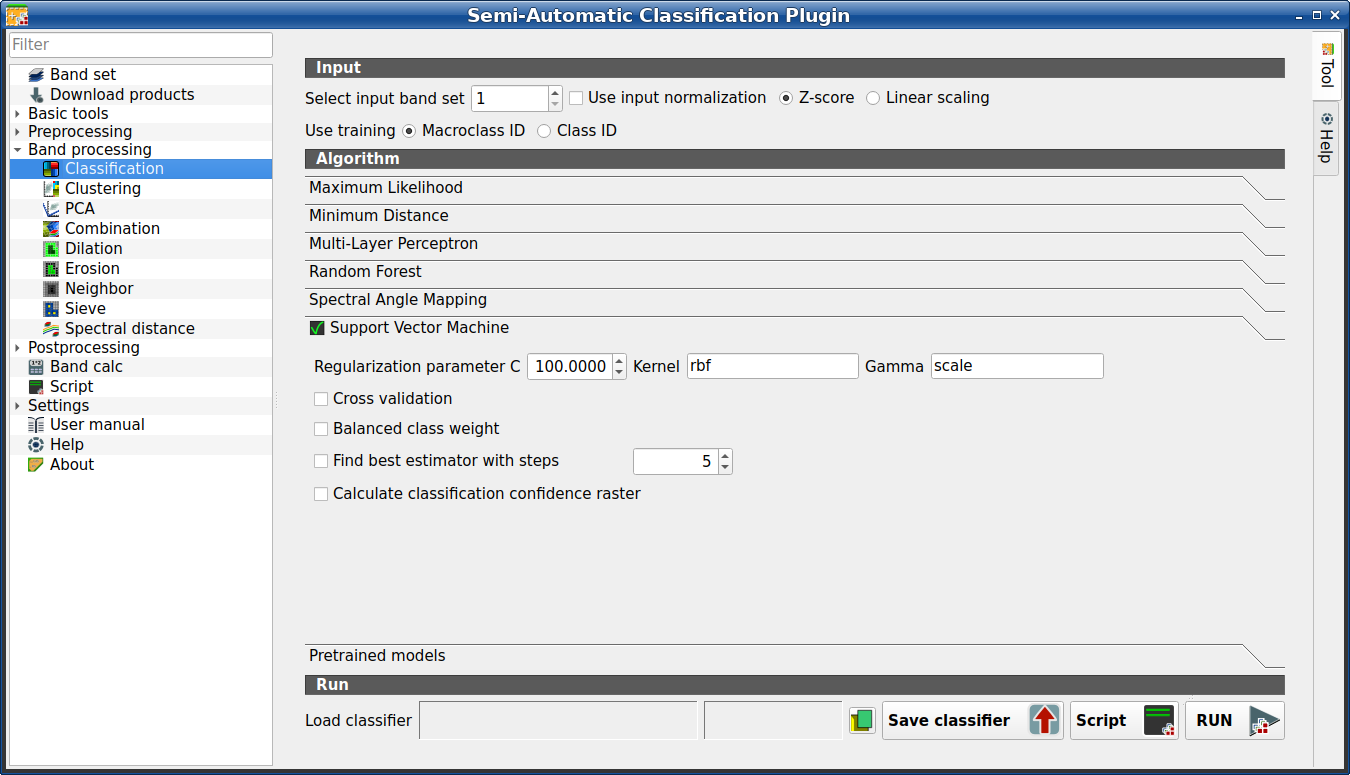
Máquinas de Soporte de Vectores
Usa el algoritmo de Support Vector Machine.
Símbolo de la herramienta y nombre |
Descripción |
|---|---|
Parámetro de Regularización C |
define el parámetro de regularización C |
Kernel |
define el kernel (por defecto: rbf) |
Gamma |
define el coeficiente gamma del kernel (por defecto: escala) |
|
si está marcado, se llevará acabo una validación cruzada |
|
si está marcado, se calcula un peso balanceado siendo inversamente proporcional a la frecuencia de las clases |
|
si está marcado, eneuntra el mejor estimador iterativamente usando un número de pasos |
|
si está marcado, se calculará el ráster de confiabilidad de la clasificación |
Cross validation is a function provided by scikit-learn to
avoid overfitting by splitting the training set into k smaller sets
(read more .
In particular, the function StratifiedKFold (with parameters n_splits=5,
shuffle=True) is used to create 5 sets, each one containing approximately the
same percentage of samples for each class as the complete set.
This option can potentially increase significantly the computation time.
If Find best estimator with steps is checked, the algorithm tries to find the best estimator iteratively with the defined number of steps (the more the steps, the slower the process will be), by changing the algorithm parameters.
If Balanced class weight is checked, the algorithm gives all classes equal weight with a balanced weight that is computed inversely proportional to class frequency in the training data.
3.4.5.1.2.7. Pretrained models
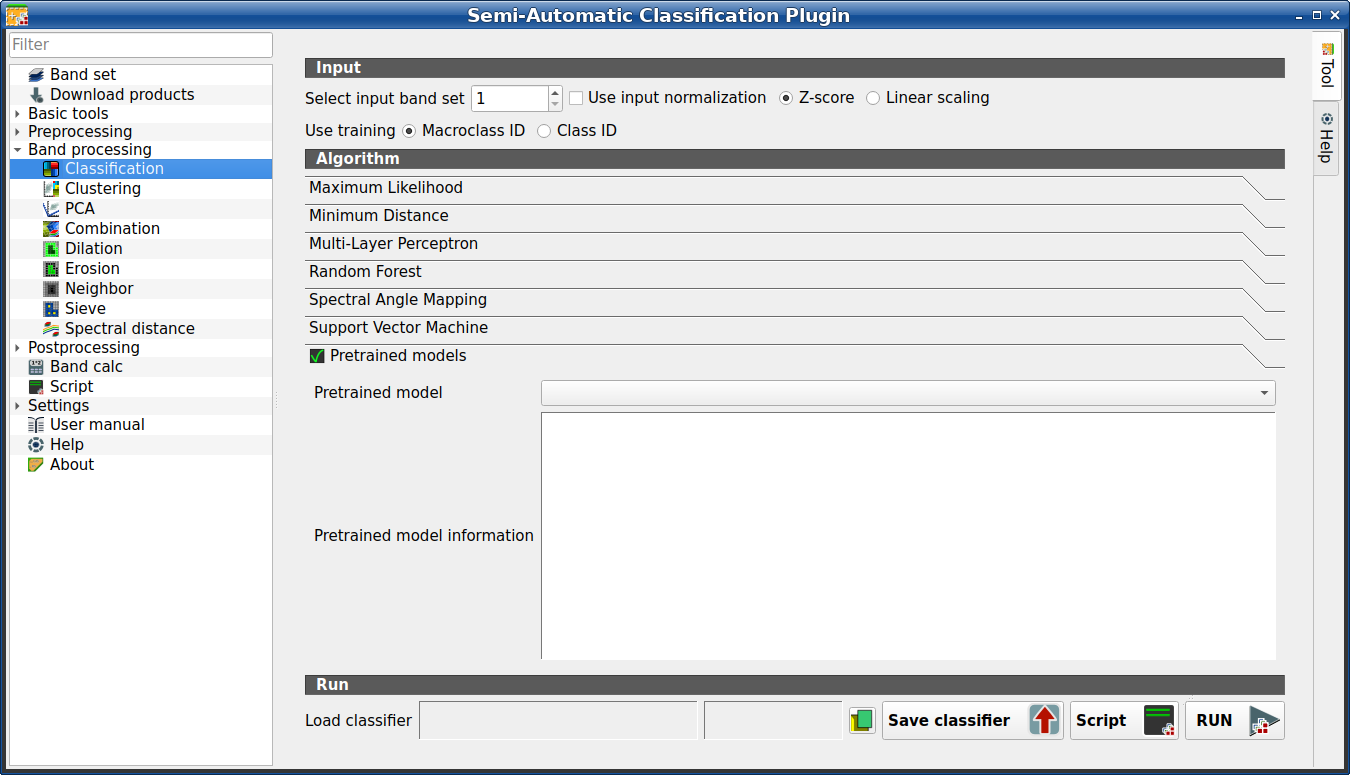
Pretrained models
Use of Pretrained models.
Símbolo de la herramienta y nombre |
Descripción |
|---|---|
Pretrained model |
select a pretrained model |
Pretrained model information |
information about the selected pretrained model, in particular about the requirements (which input bands), band normalization, and model source. |
The following Pretrained models are available for classification:
Swin-v2-Base segmentation for Sentinel-2 single image (4 bands). Requirements: Sentinel-2 bandset (TCI RGB (B04, B03, B02), TOA bands B08). Normalization: TCI RGB bands divided by 255; B08 divided by 8160 and clipped to 0-1. Output classes: background, water, developed, tree, shrub, grass, crop, bare, snow, wetland, mangroves, moss. Source: Satlas_MS_tci-b08_epoch150, pretrained by DPR Team as part of the DPR Zoo Segmentation Hub framework (https://github.com/DPR25/dpr-zoo-segmentation-hub) based on SatlasPretrain models (https://satlas-pretrain.allen.ai). The repository code is licensed under the MIT License (https://huggingface.co/martinkorelic/dpr-zoo-models). This tool downloads the model weights (DPR Team, 2025. Made as part of Arnes Hackathon 2025). All model weights remain the property of their respective authors.
Swin-v2-Base segmentation for Sentinel-2 single image (3 bands). Requirements: Sentinel-2 bandset (TCI RGB (B04, B03, B02)). Normalization: TCI RGB bands divided by 255. Output classes: background, water, developed, tree, shrub, grass, crop, bare, snow, wetland, mangroves, moss. Source: Satlas_RGB1_epoch70, pretrained by DPR Team as part of the DPR Zoo Segmentation Hub framework (https://github.com/DPR25/dpr-zoo-segmentation-hub) based on SatlasPretrain models (https://satlas-pretrain.allen.ai). The repository code is licensed under the MIT License (https://huggingface.co/martinkorelic/dpr-zoo-models). This tool downloads the model weights (DPR Team, 2025. Made as part of Arnes Hackathon 2025). All model weights remain the property of their respective authors.
The first time a pretrained models is selected, the weights thereof are downloaded and saved in the plugin directory.
Truco
The installation of PyTorch is required to run pretrained models. Please note that each model has specific characteristics and specific preprocessing of input image.
3.4.5.1.3. Ejecutar
Es posible correr la clasificación, o guardar y cargar un clasificador entrenado
El ráster de clasificación es un archivo `` .tif “” (un archivo de estilo QGIS `` .qml “” se guarda junto con la clasificación); también se pueden calcular opcionalmente otras salidas. Las salidas se cargan en QGIS después del cálculo.
Símbolo de la herramienta y nombre |
Descripción |
|---|---|
Cargar clasificador |
abrir un archivo de clasificador previamente guardado (.rsmo) |
Guardar clasificador |
guardar el clasificador en un archivo (.rsmo), para que luego pueda ser cargado |
EJECUTAR |
ejecutar esta función |


